Wildfire Smoke During Pregnancy and Autism Risk: What Recent Research Reveals
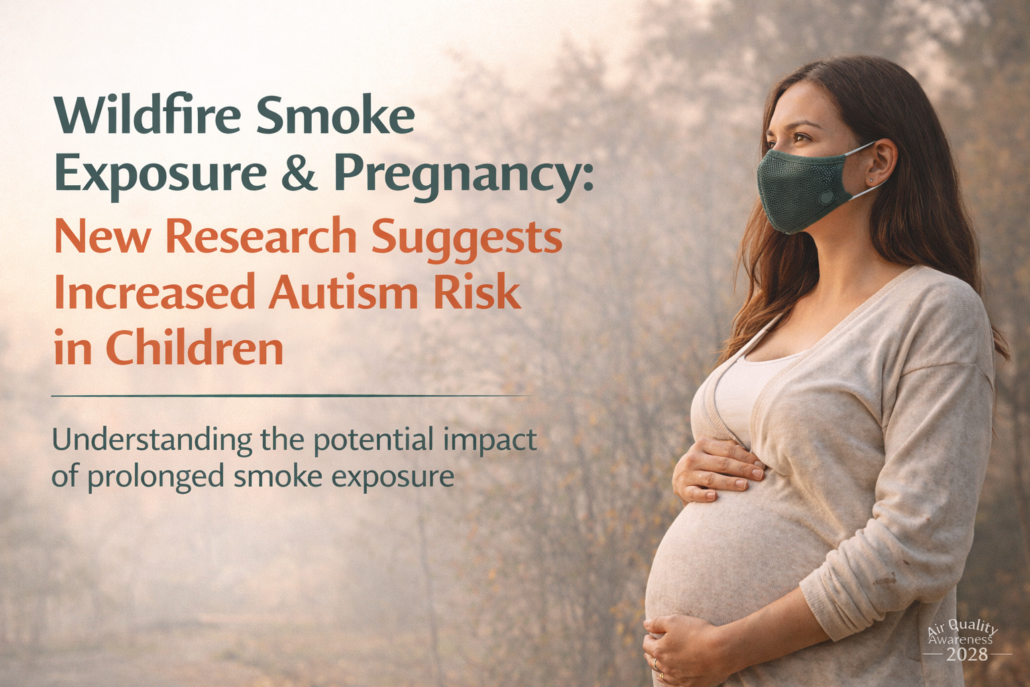
Recent research from multiple scientific teams has identified a potential link between wildfire smoke exposure during pregnancy and a higher likelihood of autism spectrum disorder (ASD) in children. While experts caution that this association does not prove causation, it adds to a growing body of evidence suggesting that environmental air pollution may influence early brain development.
What the Studies Found
Large-scale studies published in peer-reviewed journals, including Environmental Science & Technology, analyzed thousands of births in wildfire-prone regions such as Southern California. Researchers focused on prenatal exposure to wildfire smoke, particularly fine particulate matter known as PM2.5, and tracked autism diagnoses in children through age five.
The findings showed that children whose mothers were exposed to wildfire smoke during the last three months of pregnancy had a higher likelihood of receiving an autism diagnosis compared with those who were not exposed. The risk appeared to increase with the number of smoke-exposed days. When exposure exceeded ten days during late pregnancy, the likelihood of an autism diagnosis was estimated to be approximately 23 percent higher than among those with no smoke exposure.
Importantly, these associations remained after adjusting for multiple background factors, including demographic and environmental variables. The link was strongest during the third trimester, a critical period of rapid brain development in utero. However, researchers emphasize that observational studies identify correlations rather than direct cause-and-effect relationships. Autism is influenced by a complex interplay of genetic and environmental factors, and wildfire smoke is only one potential piece of that larger puzzle.
How Wildfire Smoke May Influence Fetal Development
Wildfire smoke contains high concentrations of PM2.5—microscopic particles small enough to penetrate deep into the lungs and enter the bloodstream. Once in circulation, these particles may trigger systemic inflammation and oxidative stress. Scientists are investigating whether this inflammatory response could affect the placenta or alter the in-utero environment during key stages of neurodevelopment.
Although the precise biological mechanisms are still under study, the findings align with earlier research linking prenatal exposure to air pollution with various neurodevelopmental outcomes. The third trimester appears especially sensitive because it is a period of significant brain growth, neural connectivity formation, and synaptic development.
What This Means for Expecting Parents
At this stage, researchers urge caution in interpreting the results. The studies do not prove that wildfire smoke causes autism. Instead, they highlight a potential environmental risk factor that warrants further investigation—particularly as wildfires become more frequent and severe in many parts of the western United States.
Given the broader evidence connecting air pollution to health risks, many public health experts recommend precautionary measures to reduce smoke exposure during pregnancy, especially during high Air Quality Index (AQI) days.
Practical Steps to Reduce Smoke Exposure
Monitoring local AQI reports can help expecting mothers limit outdoor activities when pollution levels rise. Staying indoors with windows closed during heavy smoke events and using high-efficiency particulate air (HEPA) purifiers can significantly reduce indoor particle concentrations. When outdoor exposure is unavoidable, wearing a high-quality, well-fitted mask designed to filter fine particles may provide an additional layer of protection.
Some families choose advanced filtration options such as nanofiber masks developed by HALOLIFE, which are engineered to balance breathability with effective particle filtration. Accessing clean air shelters or other well-filtered indoor environments during major wildfire events may also help reduce overall exposure. Expecting mothers living in wildfire-prone areas should consider discussing environmental risk reduction strategies with their healthcare providers.
A Precautionary but Important Signal
While recent studies suggest that wildfire smoke exposure during pregnancy—particularly in the third trimester—may be associated with an increased likelihood of autism in children, scientists stress that these findings do not establish direct causation. Nevertheless, the research reinforces a broader and well-established principle: air quality plays a meaningful role in overall health, including fetal development.
As wildfire seasons intensify across parts of the United States, staying informed and taking reasonable, precautionary steps to minimize smoke exposure may support maternal and child health. Reducing exposure to fine particulate matter is a practical and proactive approach, especially for vulnerable populations such as pregnant individuals.
________________________________________________________________________________________________
FAQS
Does wildfire smoke cause autism?
Current research shows an association, not proof of causation.
Why is the third trimester important?
It is a critical period of rapid brain development.
What is PM2.5 and why is it harmful during pregnancy?
PM2.5 consists of fine particles that can enter the bloodstream and trigger inflammation.
How can pregnant women reduce wildfire smoke exposure?
Monitor AQI, stay indoors during smoke events, and use air filtration or protective masks.